Alquerque
Rules of Alquerque
How to play Alquerque so that two people can sit down at a table and play the game with a drawn board and 24 pieces in total.
Game Material
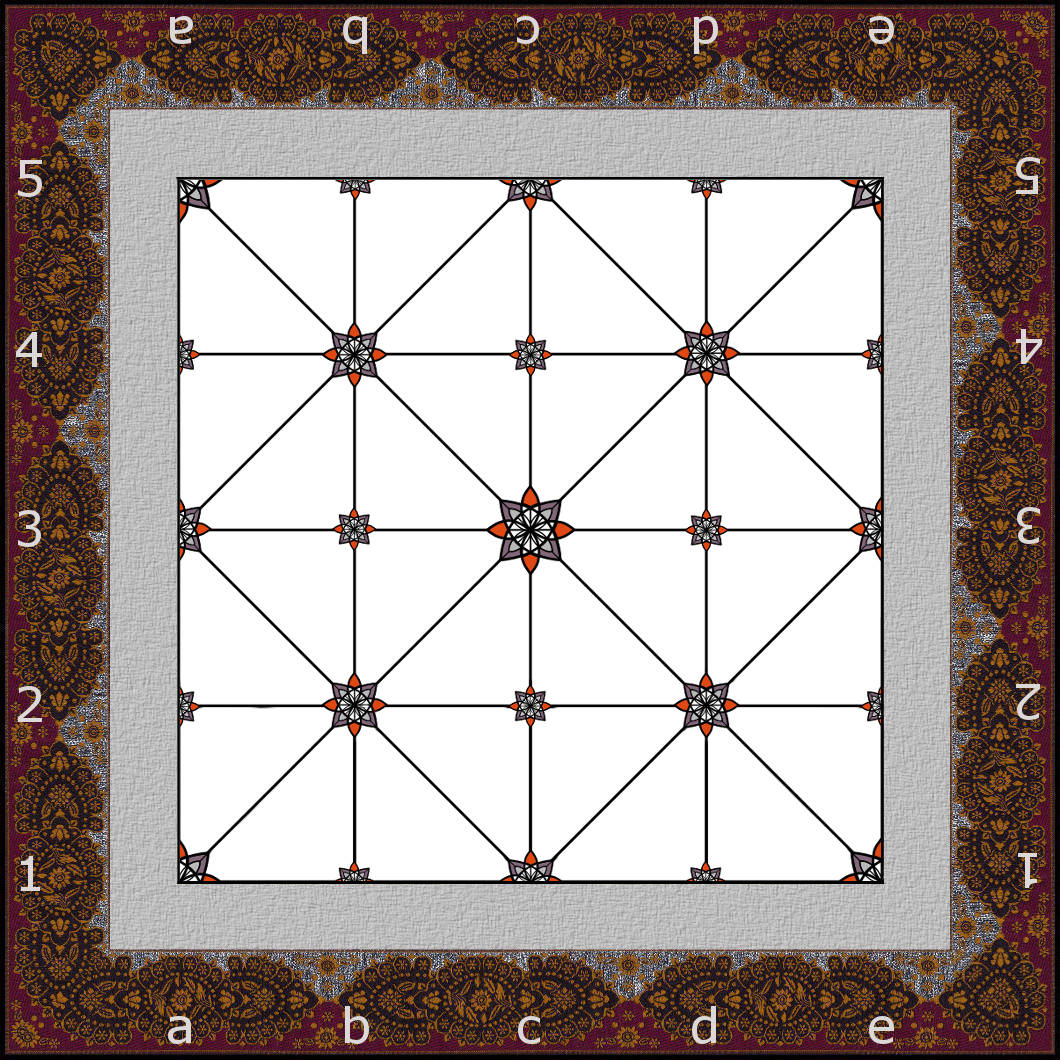
- One board with 25 points arranged as a square of 5 columns and 5 rows. The points are the intersections of the drawn lines — pieces stand on the points, not inside the squares.
- The lines connect the points like this:
- every point is connected to its direct neighbour to the left, right, above and below,
- in addition, diagonal lines are drawn so that a diagonal exists on every second point. The four corner points and the centre have diagonals; the points in between do not.
- 12 light pieces for one player and 12 dark pieces for the other. Simple draughts/checkers pieces or two colours of pebbles work fine.
For talking about positions, name the columns a to e from left to right
and the rows 1 to 5 from bottom to top. Row 1 is the home row of Light,
row 5 is the home row of Dark.
 5  b-b-b-b-b        b = dark piece
    |\|/|\|/|        w = light piece
 4  b-b-b-b-b        + = empty point
    |/|\|/|\|
 3  b-b-+-w-w
    |\|/|\|/|
 2  w-w-w-w-w
    |/|\|/|\|
 1  w-w-w-w-w
    a b c d e
Setup
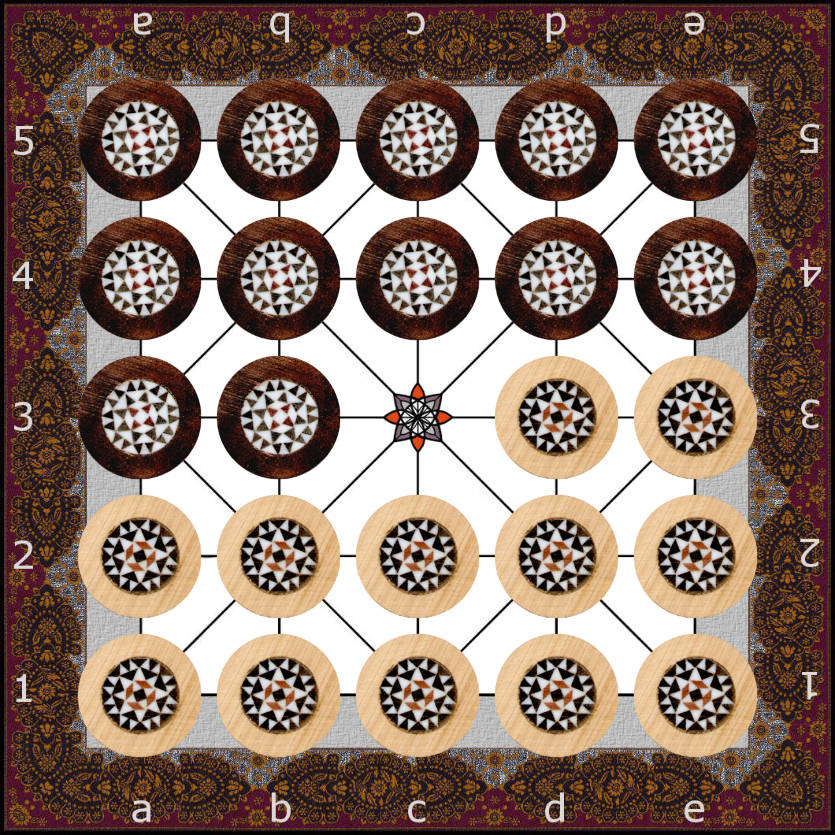
- Light fills rows 1 and 2 completely, plus the points
d3ande3. - Dark fills rows 5 and 4 completely, plus the points
a3andb3. - The centre point
c3stays empty. It is the only free point at the start.
Objective of the Game
Take all of your opponent’s pieces off the board — or leave your opponent in a position where they cannot make any legal move on their turn. In both cases you win immediately. With these rules a draw is not possible.
Rules to Move Pawns
Light moves first, then the players alternate. You must move on your turn — passing is not allowed.
On your turn:
- If you can capture, you must capture. Check this first.
- Only if no capture is available anywhere, you make a normal move.
A normal move means: take one of your own pieces and slide it along a drawn line onto the neighbouring point, which must be empty. One step only. Diagonal steps are only possible where a diagonal line is actually drawn.
Two restrictions apply to normal moves (but not to captures):
- No moving backwards. Light may never move to a lower-numbered row, Dark may never move to a higher-numbered row. Sideways and forwards is fine.
- No taking back the piece’s own last step. By default, a piece may not step straight back onto the point it came from with its own previous normal move. This history is tracked separately for every piece and prevents simple move-reversal draw cycles. The Options page can allow such inversions. Pick a different step or a different piece when they are strictly forbidden.
A piece that has arrived on the opponent’s home row (Light on row 5, Dark on row 1) is stuck there for normal moves — it cannot be moved any more. It may still capture, and once a capture has carried it off that row it can move normally again.
Pieces never stack. Only one piece per point.
Capturing
Capturing works like in draughts, by jumping:
- Your piece stands next to an opponent’s piece along a drawn line, and the next point behind that opponent’s piece on the same straight line is empty.
- Then you lift your piece over the opponent’s piece and put it down on that empty point. The jumped piece is removed from the board at once and never comes back.
- Exactly one piece is jumped per jump. You may never jump over your own pieces and never over two pieces at the same time.
- Jumps may go in any direction along the lines — including backwards toward your own home row. The no-backwards rule applies to normal moves only.
Captures are compulsory. If any capture is available at the start of your turn, you must play a capture instead of a normal move.
Multiple jumps: after a jump, if the very same piece can jump again, it must do so, and it keeps jumping until no further jump with that piece is possible. All of that is one single turn. Between jumps the direction may change. You cannot jump straight back the way you came, because the point you just jumped over is now empty.
You do not have to choose the longest capture sequence. If several captures or several continuations are available, you may freely pick any of them.
Sample Game
Starting position, Light to move. The only empty point is c3.
- Light
c2–c3. Light steps its piece forward into the free centre point. The pointc2is now empty. - Dark must capture
c4 x c3 – c2. Dark’s piece onc4is adjacent to Light’s new piece onc3along the vertical line, andc2behind it is empty. The Light piece is removed, Dark now stands deep inside Light’s camp. Score: Light 11, Dark 12. - Light must capture in return, e.g.
c1 x c2 – c3. The Dark piece onc2is removed and Light occupies the centre again. Score: Light 11, Dark 11.
The game continues in this style. Material usually stays balanced for a while, until one player runs out of safe moves and is forced to offer a piece. Keep the compulsory-capture rule in mind: a well-placed sacrifice can drag your opponent’s piece into a position where you answer with a long multiple capture.